Free Resume Grammar Checker: Boost Your ATS Score
Grammar
Spell Checker
ATS Compatibility
Catch every grammar, spelling, and punctuation error in your resume with ResumeUp.AI's free AI resume grammar checker — and boost your ATS score in seconds.
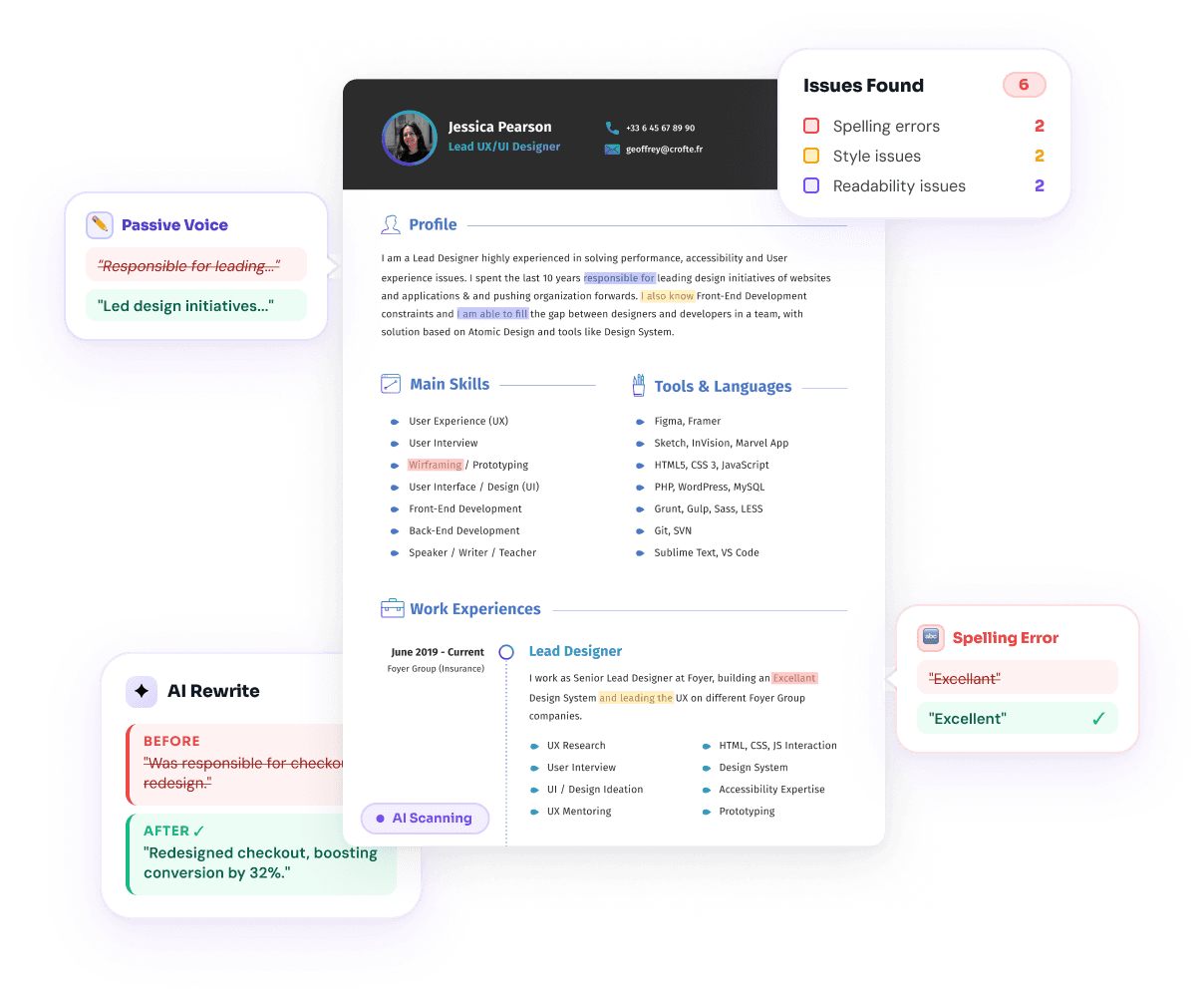
Features of ResumeUp’s AI Grammar Checker Tool
Unlike other resume grammar checkers, our tool is completely resume-focused and is designed to work on resumes specifically. Wrap up your application process with an error-free resume using AI resume grammar checker or create one from scratch with our AI resume builder.
Why Should You Check Your Resume Grammar?
Resume grammar is one of the most crucial things to be checked. Even a small odd in a resume can make the recruiter lose an impression of you. Resume grammar reflects your professionalism, and any grammatical errors will lead to the loss of a positive impression for the recruiter. One of the most common mistakes to avoid in a resume is neglecting proofreading. While other components like keywords, format, etc., may contribute to conveying information about you, resume grammar plays an equally important role, as everything else may go in vain without it.
How to Use a Resume Grammar Checker?
Give no chance to the recruiter to dismiss you. Give a final touch with a perfect resume with proper resume grammar with our resume grammar checker. No effort, just a perfect resume!
Grammar Rules to Follow for Resume Building
To keep your resume clear, impactful and error-free, understand the following grammar rules for resume building.
Grammar Mistakes to Avoid While Building a Resume
The smallest of the mistakes while building a resume might have a large impact. Avoid these common grammar mistakes while building your resume.
" width="1.0032000355720356px"/><path d="M 21.6 0 C 22.925 0 24 1.075 24 2.4 L 24 19.2 C 24 20.525 22.925 21.6 21.6 21.6 L 2.4 21.6 C 1.075 21.6 0 20.525 0 19.2 L 0 2.4 C 0 1.075 1.075 0 2.4 0 Z M 21.6 2.4 L 2.4 2.4 L 2.4 19.2 L 21.6 19.2 Z M 18 14.4 C 18.635 14.401 19.159 14.896 19.197 15.53 C 19.234 16.163 18.771 16.717 18.14 16.792 L 18 16.8 L 6 16.8 C 5.365 16.799 4.841 16.304 4.803 15.67 C 4.766 15.037 5.229 14.483 5.86 14.408 L 6 14.4 Z M 9.6 4.8 C 10.925 4.8 12 5.875 12 7.2 L 12 9.6 C 12 10.925 10.925 12 9.6 12 L 7.2 12 C 5.875 12 4.8 10.925 4.8 9.6 L 4.8 7.2 C 4.8 5.875 5.875 4.8 7.2 4.8 Z M 18 9.6 C 18.663 9.6 19.2 10.137 19.2 10.8 C 19.2 11.463 18.663 12 18 12 L 14.4 12 C 13.737 12 13.2 11.463 13.2 10.8 C 13.2 10.137 13.737 9.6 14.4 9.6 Z M 9.6 7.2 L 7.2 7.2 L 7.2 9.6 L 9.6 9.6 Z M 18 4.8 C 18.635 4.801 19.159 5.296 19.197 5.93 C 19.234 6.563 18.771 7.117 18.14 7.192 L 18 7.2 L 14.4 7.2 C 13.765 7.199 13.241 6.704 13.203 6.07 C 13.166 5.437 13.629 4.883 14.26 4.808 L 14.4 4.8 Z" fill="rgb(255, 82, 74)" height="21.599999999999998px" id="slSwbKVN6" width="24px"/></g></svg>)
" height="22.14982930494575px" id="xX0oocms_" width="23.945999999999913px"/></svg>)
Frequently Asked Questions
How do you check grammar on a resume?
Checking your resume's grammar is a very beneficial and essential step. To check your resume's grammar, you can either go for manual checking or AI-powered online resume grammar checkers.
Manual grammar checking might be time-consuming and also inaccurate to some extent. That's why ResumeUp is here with its free online resume grammar checker that instantly identifies all the errors and gives AI-driven suggestions to enhance your resume within seconds.
Can I say 'I' in a resume?
While you should keep your sentences in first-person, you should avoid mentioning the first-person pronouns like 'I',' me', etc. You can directly state your achievement or skill by starting with a strong action verb.
The sentence should imply the first-person, but it is recommended to avoid the inclusion of these pronouns to maintain professionalism and less repetition. Resumes follow concise and professional statements, which reflect action-driven work instead of a personal story.
What words should be avoided in a resume?
Avoid vague words that every normal candidate uses in their resume. For example, 'responsible', 'team player', 'hard worker', 'flexible', etc.
These words are very common and recruiters wish not to come across these words again and again because they expect resumes that are more than generic documents. Use strong and unique words that properly align with the role's environment and can impress the recruiter.
For such unique words to use on your resume, you can use our free resume grammar checker, wherein you are provided with AI suggestions that improve the content of your resume. You can also use an AI resume builder to craft a polished resume from scratch.
Is it enough to proofread using online grammar checkers?
While online grammar checkers are the best options to check your resume's grammar, you will still have to review it once manually for the safer side.
However, it is highly recommended to use resume-centered grammar checkers instead of general ones, to give a proper touch to your resume. Use our free resume grammar checker, one of the leading and successful tools, to ensure your resume is error-free.
Does grammar matter in a resume?
Absolutely, yes. Your resume's grammar plays a key role in shaping the impression that the recruiter has got on you.
Even if your skills and experience might impress the recruiter, if your grammar is not proper, then it will get the recruiter thinking that you lack proper communication skills and attention to detail. These skills are necessary in any role, and so improper grammar creates doubts about your competency for the role.
Accurate resume grammar reflects professionalism, clarity, and attention to detail.
Should bullet points end with periods?
It is your choice whether you include a period at the end of the bullet point or not, but you should be consistent with it. Including the period for one bullet point and avoiding it for the other one should be avoided.
If you are using the full stop (.) at the end of one bullet point, then use it for the remaining bullet points as well, and if you are not using it for any, then avoid it for all the bullet points. Need help writing effective bullet points? Try tools like resume bullet point generator.
Is passive voice okay in a resume?
Avoid using passive voice in the resume. Active voice shows a strong impact and should be preferred over passive voice.
For example, you should write 'Developed a mobile app that improved the user engagement by 54%' instead of 'a mobile app that improved the user engagement by 54% has been developed'. Active voice is more professional and encouraged by recruiters and also Applicant Tracking System [ATS].
Which is the best resume grammar checker?
ResumeUp's AI online resume grammar checker is trusted by thousands of users and has corrected thousands of resumes. All you have to do is upload the resume and apply the suggestions.
You will also see the identified grammar mistakes to help you understand better the errors and the AI-driven suggestions to improve the readability and clarity of the resume.
Is it okay to use abbreviations in a resume?
Avoid using short forms unless they are widely recognized in the industry. Try to include the full form so that it seems professional, and it can be easily interpreted by ATS to help in your resume ranking.
Which tense should I use in my resume?
Use the present tense if you are talking about the current role or work, and use the past tense if you are explaining your previous work. However, try to be consistent with one tense throughout the resume to avoid annoying and confusing the recruiter.