All Blogs
25+ Hard Skills to Put on a Resume in 2026 (Examples)
Not sure which hard skills to list on your resume? Get 25+ examples by industry, how many to include, and where to place them to beat ATS screening.
Recruiters and ATS software both scan for hard skills first - they're the keywords that signal you can actually do the job. Miss the ones a role calls for, and your resume can get filtered down the stack before anyone reads it.
Hard skills are quantifiable and teachable abilities necessary to complete a certain task or a set of tasks. They are increasingly important these days, given that the World Economic Forum reports that 39% of people's skill sets will be transformed or outdated by 2030.
In this guide, you'll find clear answers to the most common questions about hard skills on a resume:
What are hard skills, and how do they differ from soft and technical skills?
What are the top hard skills to put on a resume in 2026?
Which hard skills matter most in your industry — software engineering, accounting, marketing, healthcare, and more?
How many hard skills should you list, and where should they go?
How do you choose the right hard skills and prove them to employers?
Quick Summary
Hard skills are the technical or job-related skills that can be learned, measured, and demonstrated, such as coding, data analysis, bookkeeping, and graphic design. The high-in-demand hard skills in 2026 are prompt engineering, data analysis, project management, cloud computing, cybersecurity, and SQL. As you prepare your resume, ensure that you place 5-10 hard skills related to the job description in the summary, skills section, and work experience. Remember that applicant tracking systems(ATS) search for specific hard skills first, so the right ones get you past the screening test.
Top Hard Skills in Demand for 2026
Hard Skill | Why it's in demand (2026) | Source |
|---|---|---|
AI literacy / prompt engineering | Postings requiring AI literacy up 70%+ YoY | |
Data analysis | #1 new tech skill required in job postings (36% of orgs) | |
Cybersecurity | Top-3 tech skill (21%); info-security analysts projected +29% by 2034 | |
Cloud computing | Core driver of IT product/service demand fueling info-sector growth | |
Financial reporting | #5 fastest-growing skill category on LinkedIn's 2026 list |
What's the Difference Between Hard Skills, Soft Skills, and Technical Skills?
Hard skills are what you can do, soft skills are how you work, and technical skills are a subset of hard skills that involve tools and software. All technical skills are hard skills, but not all hard skills are technical skills.
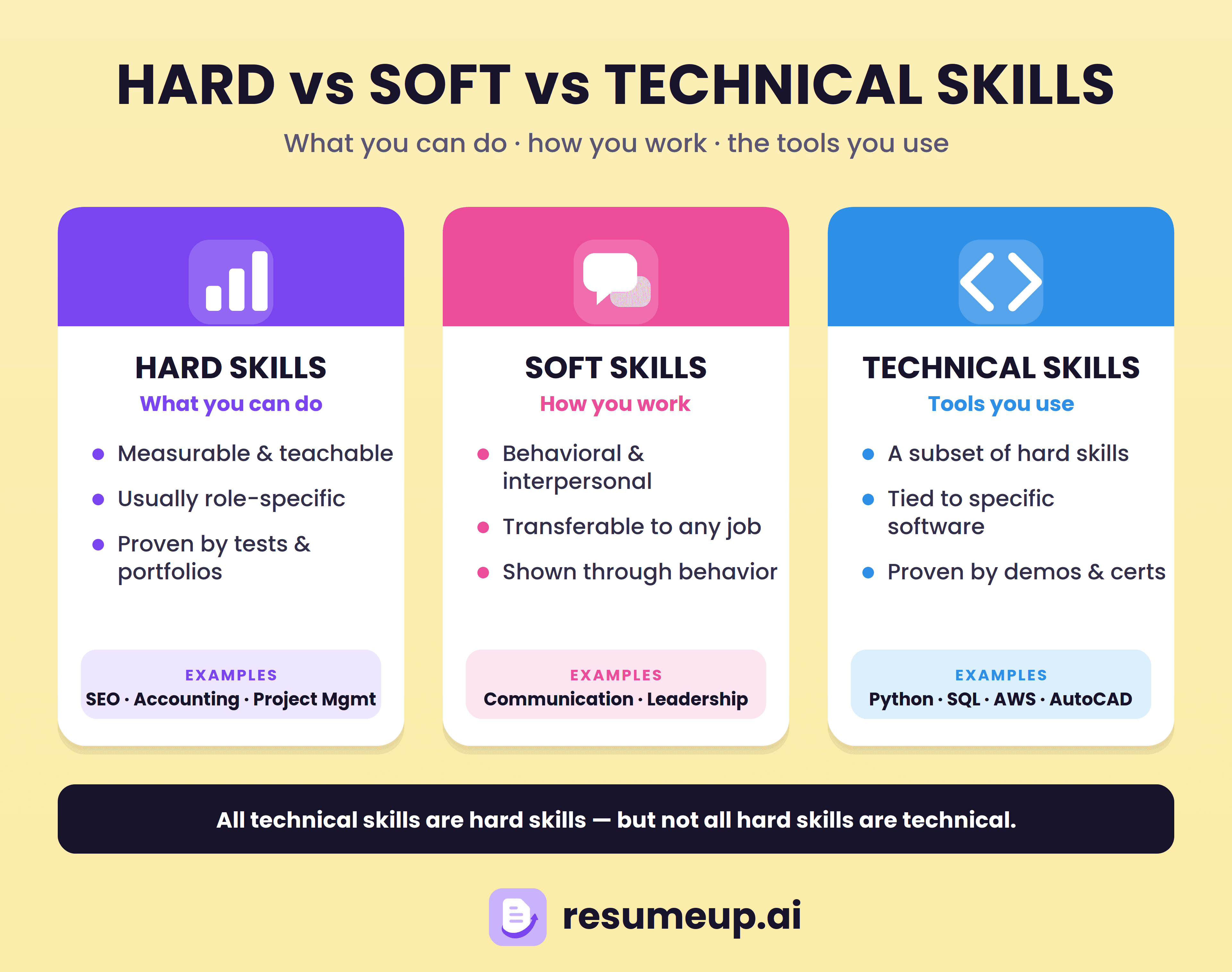
Hard Skills | Soft Skills | Technical Skills | |
What they are | Measurable, job-specific abilities | Interpersonal, behavioral traits | Tools/software/equipment skills (a subset of hard skills) |
How you learn them | Courses, certifications, practice | Experience, self-awareness | Training, hands-on use, certifications |
How they're proven | Tests, portfolios, credentials | Behavior, references, interviews | Demos, assessments, certifications |
Transferable? | Usually role-specific | Yes — apply to any job | No — tool/role-specific |
Examples | SEO, accounting, foreign languages, project management | Communication, leadership, teamwork | Python, SQL, AWS, AutoCAD, Adobe Suite |
Focus on hard and technical skills for that particular job, and complement them with appropriate soft skills. Make sure that the combination of skills matches the requirements of the targeted job.
What Are The Top Hard Skills To Put On A Resume? (25+ Examples)
The top hard skills in 2026 come from tech, data, and analytics - the World Economic Forum includes AI, big data, and cybersecurity as some of the fastest-growing skills through 2030.
Below is a list of 25 in-demand hard skills that you can add to your resume, along with an explanation of what each signals to employers. Select those that align with your targeted job description, or use the Resume Skills Generator to generate the skills with less effort.
Data analysis — turning raw data into decisions (Excel, SQL, Python).
Artificial intelligence & machine learning — building, training, and applying models.
Cloud computing — deploying and managing on AWS, Azure, or Google Cloud.
Cybersecurity — protecting systems through encryption and threat assessment.
SQL & database management — querying and maintaining structured data.
Python programming — automation, scripting, and data science.
JavaScript & web development — building sites and apps (React, Node.js).
Project management — delivering work on time using Agile, Scrum, or Jira.
Search engine optimization (SEO/SEM) — driving organic and paid traffic.
Digital marketing — running campaigns across content, social, and email.
Google Analytics — measuring and reporting on performance.
Financial modeling & analysis — forecasting, budgeting, and valuation.
Accounting software — managing books in QuickBooks, Xero, or SAP.
Microsoft Excel — pivot tables, VLOOKUP, and advanced formulas.
Data visualization — presenting insights in Tableau or Power BI.
Graphic design — creating visuals in Adobe Photoshop and Illustrator.
UX/UI design — designing user flows in Figma (wireframing, prototyping).
Video editing — producing content in Premiere Pro or Final Cut Pro.
CAD software — engineering and product design in AutoCAD or SolidWorks.
Copywriting — writing persuasive, conversion-focused content.
CRM platforms — managing pipelines in Salesforce or HubSpot.
Supply chain & operations management — logistics, inventory, lean methods.
Foreign-language proficiency — bilingual or multilingual fluency.
Medical coding & EHR systems — ICD-10 and electronic health records.
Statistical analysis — modeling data in R, SAS, or SPSS.
DevOps & automation — streamlining deployment with CI/CD, Docker, Kubernetes.
Technical writing — producing clear documentation, manuals, and guides.
Email marketing — building and optimizing campaigns (Mailchimp, A/B testing).
Bookkeeping & taxation — managing records under GAAP and IRS rules.
Risk management — identifying and mitigating financial or operational risk.
Hard Skills By Industry Examples
Different job roles require specific hard skills; therefore, the list is divided into industries. Identify your own industry and compare your resume with the required skillset using an ATS Resume Checker. The following are a few hard skills examples by career:
Mechanical Engineering
CAD software
AutoCAD: 2D/3D designs, layers.
SolidWorks: 3D modeling, simulation.
Thermodynamics
Principles: Laws of thermodynamics, energy transfer.
Applications: HVAC systems, engine design.
Electrical Engineering
Analog Circuits: Resistors, capacitors, transistors.
Digital Circuits: Logic gates, flip-flops, microprocessors.
Microcontrollers Programming: C/C++ for embedded systems.
Microcontrollers Applications: Firmware, sensors, actuators.
PLC Programming Ladder Logic: Control circuits, timers, counters.
PLC Programming HMI Integration: User interfaces, control systems.
Civil Engineering
Load Calculations: Stress, strain.
Software: STAAD.Pro, SAP2000.
Surveying
Techniques: Theodolites, total stations, GPS.
Mapping: Topographic maps and site plans.
Construction Management Project Planning: Scheduling, MS Project, Primavera.
Construction Management Quality Control: Safety standards, regulations.
Chemical Engineering
Process Simulation Software: Aspen HYSYS, CHEMCAD.
Modeling: Reaction kinetics, mass transfer.
Chemical Safety Standards: OSHA regulations, hazardous materials.
Risk Assessment: Safety protocols.
Lab Techniques
Experimental Skills: Laboratory equipment, data analysis.
Analytical Methods: Spectroscopy, chromatography.
Robotics
Languages: Python, C++.
Libraries: ROS, OpenCV.
Mechanical Design
CAD for Robotics: Kinematics, dynamics.
Prototyping: 3D printing, CNC machining.
Automation tools
Control Systems: Automated machines and processes.
Software: UiPath, Automation Anywhere.
Software Engineering
Programming Languages: Java, Python, C++, JavaScript
Data Structures and Algorithms: Sorting, Searching, Trees, Graphs
Web Development: HTML, CSS, React, Node.js
Databases: SQL, MongoDB, PostgreSQL
Version Control: Git, GitHub, Bitbucket
Data Science
Programming Languages: Python, R, SQL
Data Analysis Tools: Excel, Pandas, NumPy
Machine Learning Algorithms: Linear Regression, Decision Trees, K-Means Clustering
Data Visualization: Tableau, Power BI, Matplotlib, Seaborn
Big Data Technologies: Hadoop, Spark
Digital Marketing
SEO and SEM: Keyword Research, On-Page SEO, Google Ads, Bing Ads
Social Media Management: Content Creation, Hootsuite, Buffer
Content Marketing: Blogging, Copywriting, Video Editing
Email Marketing: Mailchimp, Campaign Monitor, A/B Testing
Analytics Tools: Google Analytics, SEMrush, Moz
Business and Management
Financial Analysis: Excel for Financial Modeling, Financial Ratios
Project Management: Gantt Charts, Microsoft Project, Trello
Business Analytics: Tableau, Power BI, Business Intelligence
Marketing Strategies: Market Research, SWOT Analysis, Digital Marketing
Operations Management: Supply Chain Management, Lean Management
Healthcare and Medical
Basic Medical Training: First Aid, CPR, Patient Care Basics
Medical Terminology: Understanding Medical Jargon, ICD-10 Coding
Clinical Skills: Phlebotomy, EKG, Patient History Taking
Public Health: Epidemiology, Health Promotion, Disease Prevention
Healthcare Software: Electronic Health Records (EHR), Medical Billing Software
Finance and Accounting
Accounting Software: QuickBooks, Xero, Microsoft Excel
Financial Reporting: GAAP, Financial Statement Analysis, Budgeting
Taxation: Tax Preparation, IRS Regulations, Tax Planning
Investment Analysis: Portfolio Management, Risk Assessment, Financial Markets
Auditing: Internal Controls, Compliance, Audit Procedures
Designing
Graphic Design: Adobe Photoshop, Illustrator, InDesign
Web Design: HTML, CSS, JavaScript, WordPress
UI/UX Design: Wireframing, Prototyping, User Research
Motion Graphics: After Effects, Premiere Pro, Animation Techniques
Product Design: Sketch, Figma, CAD Software
Legal Studies
Legal Research: Westlaw, LexisNexis, Case Law Analysis
Paralegal Skills: Legal Documentation, Case Preparation, Client Communication
Contract Law: Contract Drafting, Review, Negotiation Skills
Criminal Law: Criminal Procedures, Evidence Handling, Legal Writing
Corporate Law: Corporate Governance, Mergers and Acquisitions, Compliance
Education and Teaching
Curriculum Planning: Lesson Planning, Educational Standards, Assessment Methods
Classroom Management: Behavior Management, Student Engagement Techniques
Education Technology: Learning Management Systems (LMS), Interactive Whiteboards
Special Education: IEP Development, Inclusive Teaching Strategies
Instructional Design: Course Design, E-Learning, Blended Learning
Hospitality
Customer Service: Communication Skills, Conflict Resolution, Guest Relations
Event Planning: Event Coordination, Budget Management, Vendor Negotiation
Management: Revenue Management, Front Desk Operations, Housekeeping Management
Tourism
Culinary Skills: Food Preparation, Menu Planning, Nutrition
Travel Coordination: Travel Booking Systems, Itinerary Planning, Cultural Awareness
How Do You Choose the Right Hard Skills And Prove Them to Employers?
Choose hard skills based on how well they match up with the wording used in the job description for the position you’re aiming for, using in-demand tools rather than old versions. Prove your capabilities through quantifiable results in the work experience section, in recent certifications, and in your portfolio. Just mentioning the skill isn’t enough; you need to demonstrate your ability with the skill through measurable results.
Four tips that make the difference between a skills list that gets interviews and one that gets ignored:
Tailor your resume
Adding exact or equivalent skills mentioned in the job description to the resume helps in the ATS system, HR, and hiring manager screening.
Don't send the same resume to all the job openings; instead, send an optimized version to each job description.
Quantify everything
Highlight your potential in a quantifiable way. For example, if you are a digital marketer, show the exact number of times you helped the website improve traffic or helped the company achieve the sales target.
Keep it relevant and current
Only add relevant hard skills to your profile. Hiring managers are not interested in what you did five years ago, as the technologies keep evolving. Mention the current platforms and technology you are working on.
Make separate sections for the latest achievements and the certification courses you recently did.
Format them so they get noticed
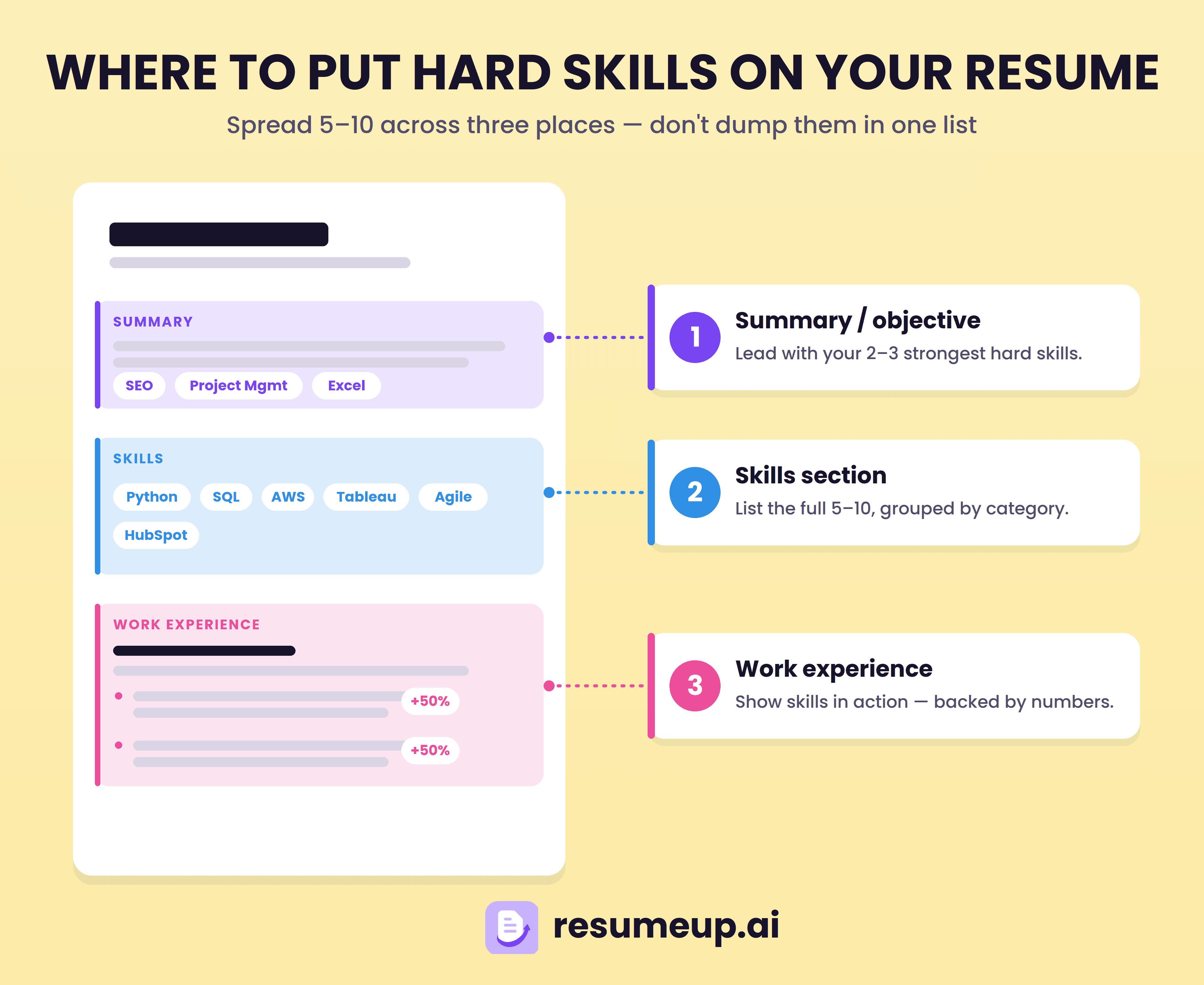
Proper formatting helps highlight your skills better. The following are ways to format skills on your resume:
Add 2-3 of the most important skills in the resume summary or objective section.
In work experience, projects, education, and achievements sections, include them in the descriptions.
Add a separate section for showcasing skills.
Also, check out the font size and style. Leave adequate margins on both sides of the resume.
How to Balance Hard Skills vs Soft Skills on a Resume?
Balance hard and soft skills together in your work experience bullets rather than separating them. Use numbers to quantify your hard skills and add real context to your soft skills. Your skills section will take care of that first glance by your ATS.
Follow the tips below to achieve the right balance between hard skills and soft skills on a resume.
Combine hard and soft skills in your work experience
A separate skills section grabs the quick attention of the hiring manager, but strategically combining soft skills and hard skills in the work experience description makes your resume more authentic and genuine.
Examples:
Led a team of five to develop a CRM system using Java and SQL (Hard skill), coordinating milestones and daily stand-ups (Soft skill).
Directed an AI-based LLM project for customer support using machine learning and NLP (Hard skill), collaborating cross-functionally and conducting regular progress reviews (Soft skill).
Tailor your resume to the job description
Recognize the hard skills and soft skills mentioned in the target job description. After identifying the skills from the job description, strategically include them in the resume summary (objective), work experience, and skills sections.
Hard skills with numbers, soft skills with context
Add Hard skills with quantifiable metrics and Soft skills with the relevant context to showcase the impact.
Example:
Enhanced data processing efficiency by 50% using Python and SQL (Hard skill) while mentoring a team of analysts, improving productivity by 20%, and enabling teamwork (Soft skill).
How to Enhance Your Hard Skills?
Enhance your hard skills through on-the-job training, certification programs such as those offered by Coursera and Udemy, self-learning at sites such as Khan Academy and Codecademy, and listening to leading industry authorities. Begin by reviewing your current skills against the requirements of your chosen profession.
As a first step, reflect on your current skill set and realize the skills you want to learn. After identifying the skills, complete your learning with one of the methods below.
On-the-job training
Most employers have dedicated training programs to keep their employees' skills up to date. Participate in the training that helps you improve your preferred hard skills.
Certifications
Enrolling in courses and getting certified not only improves your hard skills but also adds credibility to your profile.
For instance, if you are in the IT industry, then to enhance your skills, you can consider the AWS Certified Solution Architect program.
The following are a few popular online certification course providers:
Coursera
Udemy
LinkedIn Learning.
Self-study
The Internet is a treasure of knowledge if you tap it right. There are many great platforms providing free courses on several topics.
For example, Khan Academy and Codecademy provide a lot of free course materials.
Experts & communities
Follow newsletters, channels, and creators relevant to your field for faster, smarter ways to build each skill.
Conclusion
Your hard skills influence which jobs land on your shortlist – and sometimes even dictate how much money you earn! Your choice of skills, their placement, and their supporting evidence determine whether the ATS promotes your resume forward or discards it without even letting anyone see it.
Make sure your skills align with your target positions, customize them to match each position description, and provide concrete proof for every skill you include. Do all three correctly, and you'll go from a list of skills to an interview-winning resume!
If manual tailoring isn't your thing, a skills-matching tool can handle the matching and formatting.
Frequently asked questions
How do I differentiate between hard skills and soft skills?
What are the latest top 20 hard skills?
How many hard skills should I put on a resume?
What is the difference between hard skills and soft skills?
What is the difference between hard skills and technical skills?
How do I list hard skills on a resume?

Rohith Reddy
Co-Founder
Rohith co-founded ResumeUp.AI after a decade building software and hiring engineers. He graduated from IIIT in Computer Science, then worked at ADP, YuppTV, and Paperguide — leading teams and conducting 500+ technical interviews as a hiring manager. He writes from both sides of the table: what recruiters actually look for, and what the candidate side of the resume actually feels like.